ZeroDevOps for Startups: Clean CI Without a Platform Team
How a growing game studio stopped building their own CI platform on AWS/GCP and got clean, reliable build/test environments without hiring a full DevOps team.
TL;DR
- Many game studios end up building a mini "cloud platform" on AWS/GCP just to run builds and tests, then hire DevOps people to keep it alive.
- That platform work is classic toil: repetitive, reactive, and scaling with more projects instead of with more players. Google SRE
- ZeroDevOps for startups means: one clear path for build and test – a control plane that gives you Linux and Windows pools for CI without needing to design and run your own platform first.
This article leans on ideas from Google's SRE view of toil (keep repetitive ops work under control) and Team Topologies' take on platform as a product: give product teams a small number of easy, paved paths instead of a maze of options.
The trap: when a game startup builds a platform by accident
Ask around in game DevOps and you'll hear a similar story: "We just wanted builds and tests… and somehow we ended up running a mini cloud."
On paper, the setup looks reasonable:
- Game backend and live services run in a managed Kubernetes cluster in the cloud.
- Builds and automated tests run on EC2 or GCP instances across Linux and Windows.
- CI is driven by Jenkins, GitHub Actions, GitLab, or a mix of tools.
In practice, for a growing studio, that often turns into:
- A web of AMIs, images, and scripts for different game branches and platforms.
- Instance groups that behave differently in each region and account.
- At least one engineer whose full-time job is "the build farm person."
Cloud vendors themselves say game CI needs highly available source control, shared storage, and dedicated build fleets for big artefacts and multiple platforms. That's accurate—but also heavy for a startup that mainly wants "fast builds and clear failures."
One studio's story: two DevOps engineers, three on-calls a week
Take a mid-sized online game studio. They have a healthy player base and a few dozen engineers across gameplay, engine, and backend.
The situation before:
- Builds and tests ran on a mix of Linux and Windows instances in the cloud.
- They needed separate build paths for:
- Linux game builds and server components.
- Windows builds (Windows 10 and Windows 11 variants) for QA and certification testing.
- To make this work, they hired two DevOps engineers to:
- Design and maintain VM images.
- Wire Jenkins and other tools into AWS/GCP primitives.
- Respond to "build farm is broken again" pings.
The problem wasn't the idea of CI/CD. It was the platform tax that came with it:
- Multiple days of setup any time a new project or platform was added.
- On-call pages several nights a week when builds stalled or runners got stuck.
- Constant guessing: is this failure in the game code, or somewhere in the pipeline and environments?
Over time, the build system felt less like a supporting tool and more like a product of its own—one that needed roadmaps, migrations, and firefighting, but didn't directly ship content to players.
ZeroDevOps: pick one lane for build and test, then get out of the way
ZeroDevOps doesn't mean "no ops anywhere." It means: for a startup, you shouldn't have to design and run your own CI platform just to ship builds.
The studio made a decision:
- Keep production servers in the cloud where they are.
- Move build and test environments into a dedicated control plane they didn't have to build from scratch.
- Let engineers ask for "Linux build capacity" or "Windows test capacity" without opening tickets to the DevOps team.
That's where a tool like ORC8R comes in: it doesn't replace your game servers; it replaces the homemade build farm with one opinionated, repeatable way to get clean build and test capacity.
The shape of the solution: Linux and Windows pools, not snowflake machines
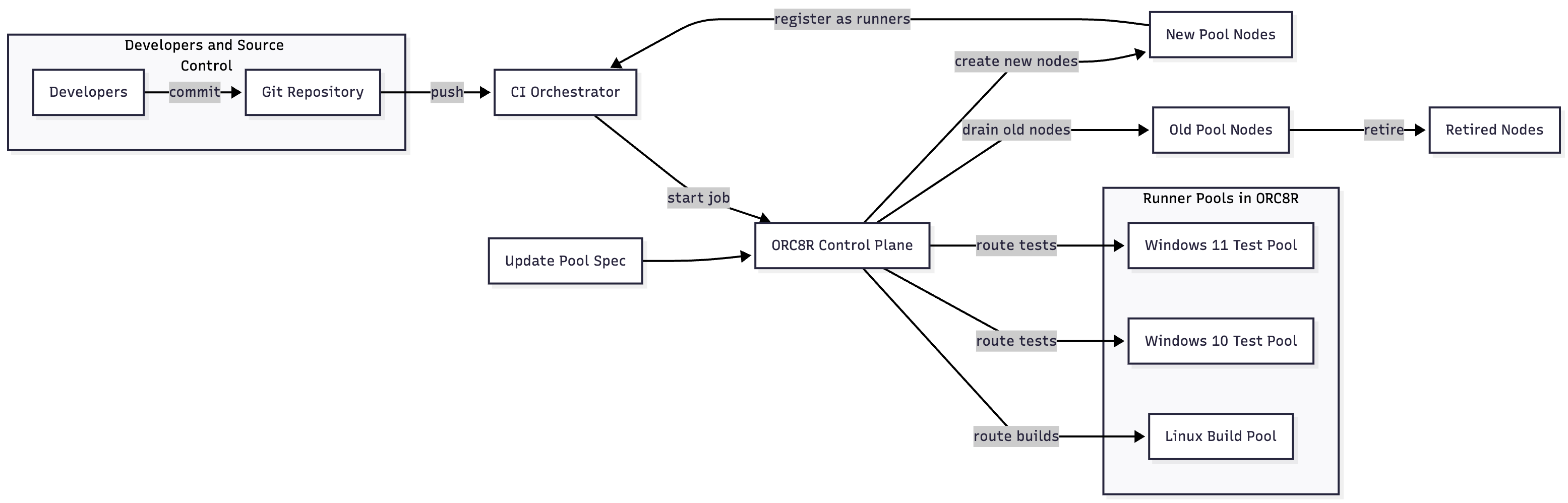
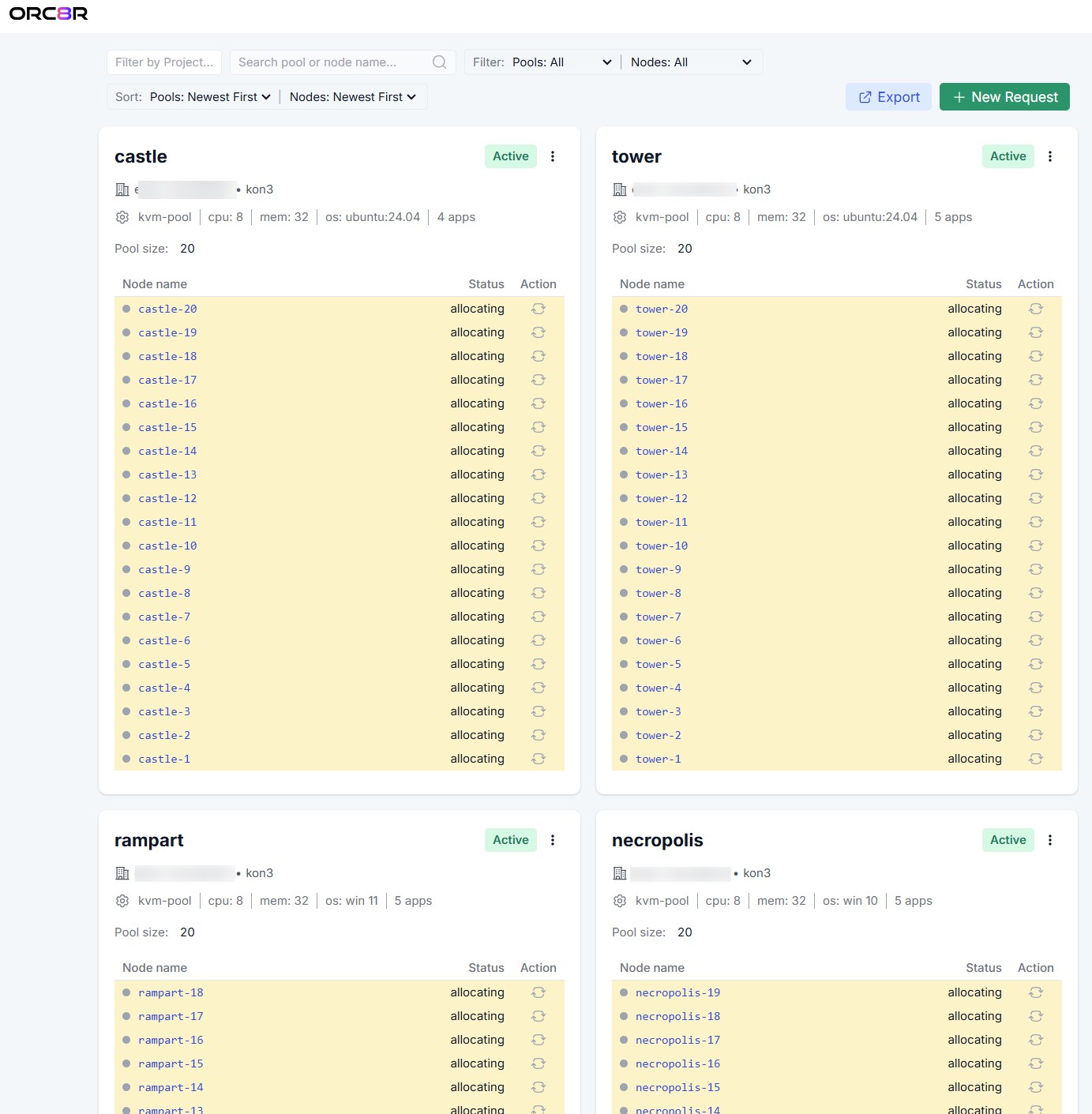
Instead of juggling individual cloud instances, they defined three pools in ORC8R:
- Linux build pool – for game and dedicated server builds.
- Windows 10 test pool – for regression tests and QA on Windows 10.
- Windows 11 test pool – for validation on Windows 11.
Each pool had:
- A base OS image (Linux, Windows 10, or Windows 11).
- A set of roles representing the toolchain:
- Game engine + build tools.
- SDKs and platform-specific libraries.
- Supporting tools like Python, test frameworks, and profiling tools.
- A connector to their CI orchestrator (Jenkins, GitHub, or whatever they were using).
Engineers no longer thought in terms of "which EC2 instance is this?" but in terms of "which pool is this job running on?" The control plane handled the rest.
From hand-tuned boxes to immutable pools
The key shift wasn't just "different VMs." It was how those VMs were treated.
Before:
- Each runner could be tweaked by hand to "fix" a build.
- Toolchains and SDKs drifted over time as different people updated different machines.
- Documentation lagged behind reality; nobody was completely sure what was running where.
After ORC8R:
- Each pool had a single source of truth: OS + roles (toolchain versions) + size.
- Changing that spec triggered a rotation of pool nodes instead of patching them in place.
- If a new engine version caused trouble, rolling back meant reverting the pool spec, not logging into a dozen boxes.
From the engineer's point of view, the workflow looked like this:
Later, when a new game engine build dropped, they updated the roles and applied the new spec. ORC8R handled creating and draining nodes so CI kept flowing.
Less guessing, fewer pages, more time on the game
Over a few months, the team saw changes that actually mattered to day-to-day life:
| KPI | Before | After |
|---|---|---|
| Time to set up build/test for a new game branch or platform | A few days of cloud + CI plumbing | Hours — define pools, attach roles, hook CI once |
| On-call pages about "CI is broken" | Several times a week | Dropped to occasional incidents, mainly real game issues |
| Engineer time lost to CI maintenance each month | Large chunks of DevOps time fixing and tuning the build farm | Mostly automated; changes flow through pool specs |
| Confidence when a pipeline turns red | "Is this the environment or the game?" | "The pools are clean and consistent; assume it's the code first." |
The DevOps work didn't disappear completely, but it became more about designing good paths and less about wrestling with one-off problems. And crucially, they didn't have to scale the platform team linearly with new game branches or platforms.
Why this matters for startups in particular
Big studios can afford to build their own platforms and maintain a team to run them. Startups usually can't.
For a younger company, the trade-offs are different:
- Every month spent building infra is a month not spent shipping features or content.
- Hiring and retaining strong DevOps/platform engineers is expensive and competitive.
- The first build system you cobble together tends to stick around for years.
ZeroDevOps for startups means:
- Pick a small number of supported paths (Linux and Windows pools for CI) instead of re-inventing the farm with each project.
- Give developers self-service controls for environments without handing them every cloud primitive under the sun.
- Keep platform work thin so you don't end up with a side-project that consumes entire headcount by itself.
The game servers can keep running on a managed cloud stack. The heavy lifting for build and test moves into a control plane that's designed to do just that, and nothing more.
Closing: CI that feels like a feature, not a second product
For this studio, the real win wasn't a new buzzword. It was the feeling that CI stopped being a second product they had to ship.
Instead of:
- Designing their own build platform on AWS/GCP.
- Hiring multiple engineers just to keep that platform healthy.
- Living in constant doubt about whether failures were infra or code.
They moved to:
- Clear, immutable pools for Linux and Windows builds and tests.
- Simple specs and logs that show when environments change.
- More time spent on the game itself instead of the machinery around it.
That's the heart of ZeroDevOps for startups: stop treating CI infrastructure as an unplanned product, and use a control plane that gives you a clean, boring path for build and test from day one.